
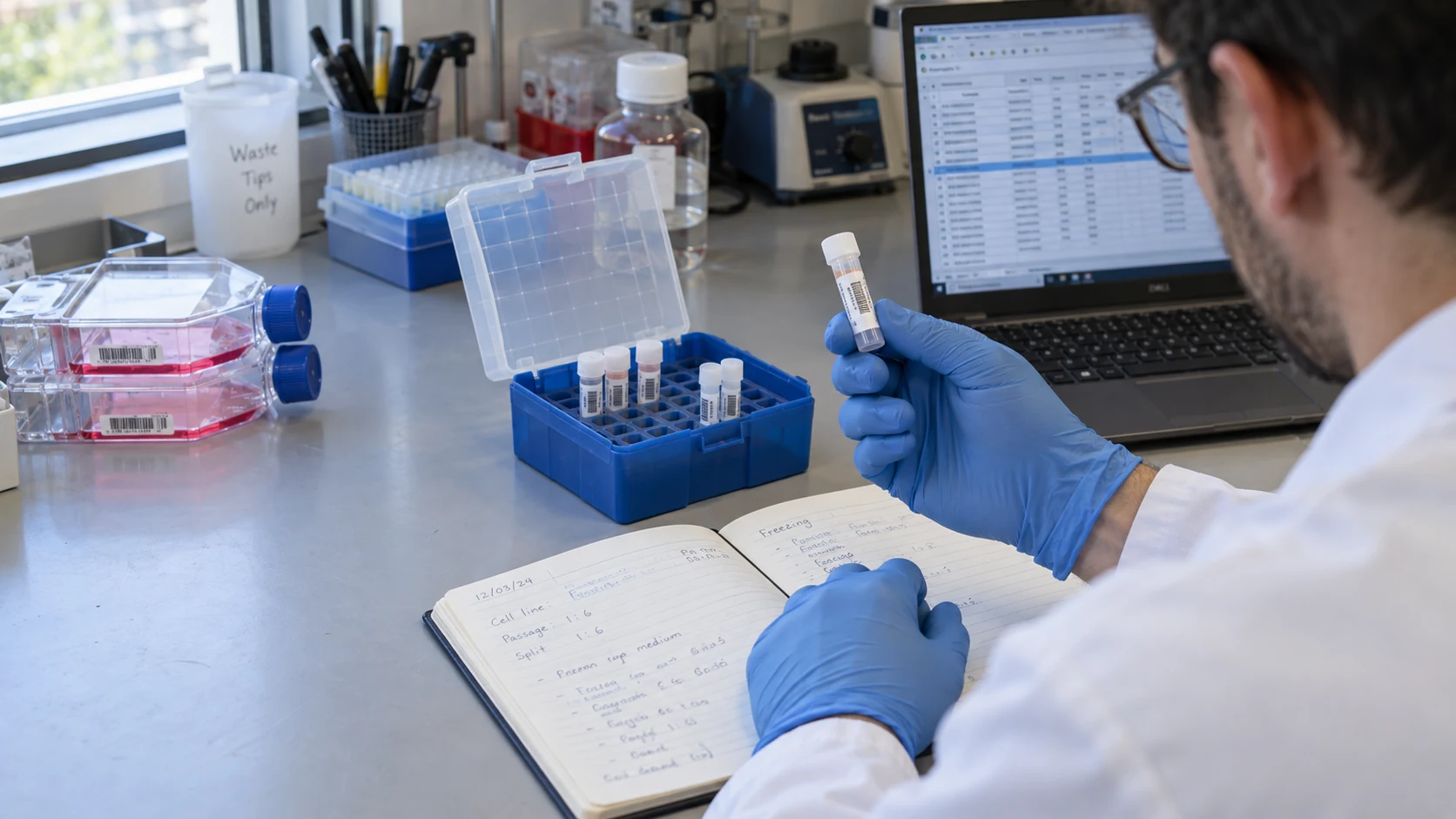

Between 18% and 36% of common cell lines in active use are estimated to be mislabelled or contaminated, according to research published in PMC. The cause is rarely deliberate negligence. It is the cumulative effect of fragmented documentation: passage histories recorded in spreadsheets that do not talk to each other, media lot numbers written in bench notebooks that are never linked to the cultures they fed, and handovers that exist only in memory. When something goes wrong, or when a result cannot be replicated, there is no connected record to interrogate.
CellHood addresses this problem by building provenance into the operational workflow rather than treating it as a separate documentation task. Every feed, passage, media preparation, and sign-off is recorded automatically at the moment it occurs, linked to the batch it belongs to, and stored in an immutable audit trail. The result is a connected record that runs from the first thaw event to the final harvest, without requiring researchers to maintain parallel documentation systems.
This guide explains how each layer of that provenance architecture works: how batch records are structured, how lineage relationships are modelled, how material lots are tied to individual culture events, and how the audit trail is generated and controlled.
Key principle: CellHood does not add a documentation layer on top of existing workflows. Provenance data is captured as a by-product of doing the work inside the platform.
Why Provenance Tracking Fails in Conventional Cell Culture Practice
Most laboratories document cell culture work through a combination of paper notebooks, spreadsheets, and informal team communication. This approach is not inherently careless; it reflects the practical reality that documentation has historically been separate from the act of doing the work. The problem is that separation creates gaps.
Good Cell and Tissue Culture Practice (GCCP) 2.0, the guidance framework developed to standardise in vitro work, identifies documentation as one of its six core operational principles. Specifically, it requires "documentation and reporting of the information necessary to track the materials and methods used, to permit the repetition of the work." The OECD Principles of Good Laboratory Practice extend this further, requiring that records for in vitro test systems include passage number, culture conditions, subcultivation intervals, and freezing and thawing conditions.
The documentation gaps that matter most
In practice, four specific failure points account for the majority of provenance breakdowns in cell culture labs:
| Failure point | Typical consequence |
|---|---|
| Passage history not linked to individual lineage branches | Cannot determine which passage a result came from when a culture splits |
| Media lot numbers recorded separately from feed events | Cannot trace a contamination event or batch variability back to a specific material |
| Protocol version not captured at time of execution | Cannot confirm which protocol version was followed for a given experiment |
| Handover documented informally or not at all | Ownership gaps create accountability blind spots in shared cultures |
Each of these gaps is individually manageable. Together, they make it nearly impossible to reconstruct a reliable history when reproducibility is questioned. A 2022 analysis published in PMC noted that cell-lineage provenance is "rarely recorded or published, despite its major impact on data reliability and reproducibility."
The core problem is structural, not behavioural. Manual documentation systems require researchers to remember to record information, to record it in the right place, and to link it correctly to the relevant culture. CellHood removes the need for all three by embedding provenance capture into the platform's operational layer.
The Batch Record: CellHood's Foundational Provenance Unit
Every culture in CellHood exists as a batch record. This is the central data object that all other provenance information attaches to. When a researcher creates a new culture, the batch record is instantiated with a unique identifier, the assigned protocol, the culture type (cell line, seed train, or differentiation run), the format (flask type and seeding density), and the assigned owner.
From that point forward, every action performed on the culture appends to the batch record automatically. Researchers do not need to navigate to a separate documentation module; completing a feed, recording a passage, or adding an observation within the normal operational workflow writes directly to the batch record.
What a batch record captures
A complete batch record in CellHood contains the following provenance layers:
-
Identity and origin: Cell line name, culture type, protocol version applied at creation, seeding date, and assigned researcher
-
Feed history: A timestamped log of every completed feed, including the media used, the prepared batch identifier, and the user who performed the action
-
Passage and day-in-vitro timeline: Passage number increments and day-in-vitro counts tracked continuously from seeding
-
Lineage relationships: Parent batch identifiers for cultures derived from an existing stock, creating a navigable parent-child chain
-
Outcome data: Predicted and recorded yield, viability measurements, and any outcome assay results linked to the protocol's defined endpoints
-
Team notes and images: Timestamped annotations and microscopy images attached at specific timepoints
-
Closure and sign-off: Batch closure status, approval records, and the identity of approving personnel
Practical implication: When a batch is closed and a report is generated, the batch record contains every piece of information required to reconstruct the culture's history without reference to any external document. This is the definition of a self-contained provenance record.
The batch record is read-only once entries are committed. Researchers cannot edit or delete historical entries, which ensures the record remains attributable and unaltered, consistent with the ALCOA principles (Attributable, Legible, Contemporaneous, Original, Accurate) referenced in data integrity frameworks for preclinical research.
Lineage Tracking: Modelling Parent-Child Relationships Across Culture Types
Lineage divergence is one of the least-documented sources of experimental irreproducibility. When a seed train stock is passaged into multiple flasks, each flask begins a separate lineage branch. If those branches are not tracked individually, there is no way to determine whether two results came from the same population or from populations that have diverged over subsequent passages.
CellHood models lineage relationships as linked batch records. When a researcher creates a new culture from an existing stock, the new batch is linked to its source batch at the point of creation. This relationship is permanent and navigable: any batch in the system can be traced back through its parent chain to the original stock.
The three lineage patterns CellHood tracks
1. Seed train to differentiation run
The most common lineage relationship in iPSC and stem cell work. A seed train batch (for example, WTC11 at passage 31) is the source for one or more differentiation runs. In CellHood, each differentiation batch references the seed train batch it was derived from, including the passage number at the time of derivation. If two cardiac differentiation runs produce different results, the lineage record immediately shows whether they came from the same passage or from different ones.
2. Cell line to seed train
Reference and working cell line records sit at the top of the lineage hierarchy. When a seed train is initiated from a banked working stock, the seed train batch is linked to the cell line record, capturing the thaw event, the vial identifier, and the passage number at the time of thaw. This creates the full chain from bank to active culture.
3. Passage continuity within a seed train
Within a single seed train, each passage event is recorded as a timestamped entry on the batch record, incrementing the passage counter. If a seed train is split into parallel flasks at passage 29, both flasks carry the same passage history up to that point, and their subsequent passage events are recorded independently from the split.
Why this matters for reproducibility
The PMC analysis on cell lineage tracking recommends that researchers "track ongoing passaging separately for each individual new lineage" when a culture is split. CellHood enforces this structurally: the platform does not allow a researcher to record a passage event without it being associated with a specific batch identifier. There is no ambiguity about which culture was acted upon.
The practical test: if a collaborating laboratory asks for the exact lineage used in a published experiment, a CellHood user can export the batch record for that culture and provide the complete passage history, media used at each passage, and the source stock it was derived from, all from a single report.
Material Provenance: Linking Media Lots to Individual Feed Events
Material traceability is the second major axis of provenance in cell culture. Knowing that a culture was fed on a given date is useful. Knowing exactly which prepared media batch was used, which formulation it was made from, and which raw material lots it contained is what makes the record actionable when something goes wrong.
CellHood handles material provenance through a two-stage model: formulations and prepared batches.
Stage 1: Formulations
A formulation in CellHood defines the composition of a media type, specifying each component, its concentration, and its role (basal medium, supplement, additive). Formulations are created once and stored in the workspace library. They are not modified after creation; if a formulation changes, a new version is created, preserving the history of what each version specified.
This is consistent with the OECD GLP Principles requirement that media characterisation records include "types of media, ingredients and lot numbers" and that standard operating procedures address the preparation and acceptance of such media.
Stage 2: Prepared batches
When a researcher prepares media from a formulation, they create a prepared batch record. This record captures:
-
The formulation it was made from (including version)
-
The lot numbers of each raw material used
-
The volume prepared
-
The preparation date and expiry date
-
The researcher who prepared it
-
A unique prepared batch identifier (for example, PM-0268)
Every subsequent feed that uses this batch references it by its prepared batch identifier. The link between a specific feed event and the exact materials used is automatic and permanent.
How lot tracking is configured
CellHood allows workspace administrators to set lot tracking as optional or mandatory, depending on the laboratory's requirements:
-
Optional mode: Researchers can complete feeds without selecting a prepared batch. Suitable for academic workflows where material traceability is useful but not required for every experiment.
-
Mandatory mode: Feeds cannot be completed without selecting a valid prepared batch from inventory. Suitable for regulated or quality-controlled environments where full material traceability is required.
The downstream value of this architecture: if a batch of raw material is later found to be problematic, a workspace administrator can search by lot number and immediately identify every prepared batch that used it, and every culture that was fed from those prepared batches. This is the kind of forward and backward traceability that manual systems cannot reliably provide.
Protocol Linkage: Capturing Which Method Was Followed and When
Protocol drift is a well-documented contributor to irreproducibility. A researcher follows a protocol as written at the time of an experiment; six months later, the protocol has been updated, and a new researcher following the current version produces different results. Without a record of which version was active at the time of the original experiment, the discrepancy cannot be traced to its source.
CellHood addresses this by linking the protocol version to the batch record at the point of culture creation, not at the point of reporting.
How protocols are structured
Protocols in CellHood are day-specific method definitions. Each protocol specifies:
-
The media to be used at each stage (by day or passage number)
-
The feed schedule (daily, every two days, or by confluence threshold)
-
The outcome assays that should be performed and when
-
The expected endpoints (for example, viable yield, purity markers, beating rate for cardiomyocyte protocols)
When a researcher creates a new culture batch, they select a protocol from the workspace library. The system records the protocol name and version at that moment. If the protocol is subsequently updated in the library, the existing batch continues to reference the version that was active when it was created.
AI-assisted protocol import
CellHood includes an AI-driven protocol conversion tool that accepts PDF and DOCX source documents and extracts stages, timings, and feed schedules into a structured draft. The researcher reviews and confirms the draft before it is added to the workspace library. Once added, the imported protocol is versioned and available for batch assignment like any manually created protocol.
This is particularly relevant for laboratories transitioning from paper-based SOPs. The original document can be imported, converted, reviewed, and version-controlled within the platform, creating a direct link between the paper SOP and the digital protocol record.
The provenance value of protocol linkage
When a batch record is reviewed or exported, the protocol version used is part of the record. This means:
-
Reproducibility queries can be answered with a specific protocol version, not just a protocol name
-
Deviations from the scheduled protocol (for example, a missed feed or a modified timepoint) appear as gaps or notes in the feed history, making them visible rather than invisible
-
Outcome assay results are linked to the protocol that specified them, so the measurement context is always clear
The Audit Trail: Immutable, Attributable, and Exportable
The audit trail is the workspace-level record of every action taken by every user, across all batches and all data objects. It is distinct from the batch record in scope: where a batch record captures the history of a single culture, the audit trail captures the history of the entire workspace.
Every entry in the audit trail contains five fields:
-
Date and time (UTC timestamp, to the second)
-
Actor (the named workspace member who performed the action)
-
Action type (for example: feed completed, media prepared, image added, sign-off, note added)
-
Record context (the specific batch or data object the action was performed on)
-
Session identifier (the authenticated session from which the action was performed)
Entries are written automatically when actions are completed. There is no manual logging step, and entries cannot be edited or deleted after they are written.
Cryptographic integrity
The audit trail in CellHood is protected by a cryptographic checksum. Each page of the audit trail displays a checksum value that allows the integrity of the record to be verified. If the underlying data were altered, the checksum would not match, making tampering detectable.
This approach is consistent with the data integrity requirements described in the OECD GLP Principles, which specify that changes to electronic records must be traceable and must not obscure the original entry.
Dual sign-off workflows
For laboratories operating under quality oversight, CellHood supports dual sign-off on batch closures. When a batch is ready to close, the assigned researcher submits it for review. A second authorised user (typically a group administrator or senior researcher) must approve the closure before the batch record is finalised. Both the submission and the approval are recorded in the audit trail with separate timestamps and actor identities.
This two-person review pattern satisfies the "review and sign-off" requirement present in many institutional quality frameworks and supports the kind of contemporaneous, dual-attributed record that GLP inspections require.
Exporting the audit trail
The audit trail can be filtered by date range, actor, or action type and exported as a controlled report. The export is timestamped and includes the cryptographic checksum of the records it covers, providing a verifiable snapshot of workspace activity for a defined period.
For compliance teams: The audit trail export is designed to be submitted directly to institutional quality assurance reviewers without requiring additional formatting or manual curation. The record is attributable, timestamped, and tamper-evident by design.
Ownership, Handovers, and Team-Level Provenance
In shared laboratory environments, the question of who is responsible for a culture at any given point is as important as what was done to it. Ownership gaps are a common source of accountability failures: a culture is handed between researchers informally, a feed is missed, and there is no record of who was responsible at the time.
CellHood assigns ownership at the batch level. Each active culture has a named owner, visible across the team dashboard and the culture portfolio. Ownership can be transferred between researchers, and each transfer is recorded in the audit trail with the date, time, and identities of both parties.
Role-based access controls
Workspace members operate under one of several defined roles:
| Role | Permissions |
|---|---|
| Workspace member | Record feeds, add notes, create batches, prepare media |
| Group administrator | All member permissions, plus approve batch closures and manage workspace settings |
| Viewer | Read-only access to batch records and audit trail |
Role assignments are recorded and visible in the audit trail. If a member's role changes, that change is timestamped and attributable.
Handover visibility
When a culture is handed over from one researcher to another, the new owner receives the full batch record as context: every feed completed, every note added, the current passage number, the next scheduled feed, and the media in inventory. There is no ambiguity about the state of the culture at the point of handover.
This is particularly valuable in facility environments where multiple researchers may work on the same culture across a week, or where cultures are maintained across staff changes. The record continuity is automatic; it does not depend on the outgoing researcher having documented their activity in a separate handover note.
The team-level provenance picture: at any point, a group administrator can view the full activity log for all cultures in the workspace, filtered by researcher, date, or culture type. This provides the operational oversight necessary for quality reviews without requiring researchers to produce separate summary reports.
Structured Outputs: Batch Reports and Feeding Reports
Provenance data is only useful if it can be retrieved and presented in a form that others can evaluate. CellHood generates two structured report types that surface the provenance record in a readable, shareable format.
Batch records report
The batch record report is a complete history of a single culture batch. It includes:
-
Batch identity, classification, and protocol version
-
Full feed timeline with dates, media used, prepared batch identifiers, and recording researchers
-
Passage history and day-in-vitro progression
-
Lineage references (parent batch identifiers)
-
Outcome assay results linked to protocol-defined endpoints
-
Closure status and sign-off record
This report is the primary document for institutional review, publication supplementary material, or regulatory submission. It requires no manual assembly; the platform generates it directly from the batch record.
Feeding report
The feeding report is an operational document that lists the daily preparation requirements for all active cultures in a workspace. It specifies media formulations, volumes, supplements, lot fields, and the cultures scheduled to be fed. Its primary use is in facilities where media preparation is centralised and needs to be planned in advance.
The feeding report also functions as a forward-looking traceability document: it specifies exactly what materials should be used for each scheduled feed, creating a reference point against which the actual feed records can be compared.
Data isolation and workspace security
CellHood workspaces are tenant-isolated: one organisation's data is not accessible to another, and workspace data is never used to train AI models or shared with third parties. This is a prerequisite for laboratories handling proprietary cell lines, confidential experimental data, or materials subject to material transfer agreements.
Role-based access controls (described in the previous section) ensure that external reviewers can be granted read-only access to specific records without being able to modify the underlying data.
Implementation Considerations by Laboratory Type
CellHood's provenance architecture is the same across all plan tiers, but the way teams configure and use it varies by context. The following guidance reflects the most common implementation patterns.
Academic research groups
For academic laboratories, the primary provenance priority is typically lineage tracking and protocol version capture, rather than full material lot traceability. The recommended starting configuration is:
-
Lot tracking set to optional (can be enabled selectively for experiments where material traceability matters)
-
Protocols imported from existing PDF or DOCX SOPs using the AI conversion tool
-
Dual sign-off enabled for batches that will be referenced in publications
The 30-day free trial on the Researcher plan provides enough time to import existing protocols, create initial batch records, and evaluate whether the lineage tracking model fits the laboratory's workflow before committing to a subscription.
Biotechnology and CRO environments
For biotech teams and contract research organisations, full material lot traceability and dual sign-off are typically required from the outset. The recommended configuration is:
-
Lot tracking set to mandatory for all feed events
-
Role-based access configured to separate bench researchers from approvers
-
Audit trail export scheduled regularly for quality record retention
The Lab and Startup plans (supporting up to 15 and 40 users respectively) include expanded API access and webhook support, which allows CellHood's provenance data to be integrated with external LIMS or data management systems where required.
Key questions to answer before configuration
Before configuring a new CellHood workspace, teams should establish answers to the following:
-
Which culture types will be tracked (cell lines, seed trains, differentiations, or all three)?
-
Is material lot traceability required for all feeds, or only for specific experiment types?
-
Who will have approval authority for batch closures?
-
Will the workspace need to produce reports for external review (institutional, regulatory, or publication)?
The answers determine the appropriate plan tier and the initial workspace configuration. CellHood's walkthrough service (available via the website) can assist with mapping existing workflows to the platform's data model before setup begins.
Summary: What CellHood's Provenance Architecture Covers
The provenance and lineage tracking system in CellHood covers five interconnected layers, each of which addresses a specific failure point in conventional cell culture documentation:
| Layer | What it captures | Problem it solves |
|---|---|---|
| Batch record | Complete per-culture history from creation to closure | Fragmented records that cannot be reconstructed after the fact |
| Lineage relationships | Parent-child links between cell lines, seed trains, and differentiation runs | Inability to determine which passage or source stock a result came from |
| Material provenance | Prepared batch identifiers and raw material lot numbers linked to individual feed events | No connection between a contamination or variability event and the materials used |
| Protocol linkage | Protocol version captured at batch creation and locked to the record | Protocol drift between the time of an experiment and the time of a review |
| Audit trail | Immutable, timestamped, actor-attributed log of every workspace action | Accountability gaps in shared environments and no tamper-evident record for compliance |
These layers are not independent features. They are a connected architecture: the audit trail references batch records, batch records reference protocols and prepared media batches, and prepared media batches reference formulations and raw material lots. A single query can traverse the full chain.
The practical outcome is that a laboratory using CellHood can answer the questions that manual systems cannot: which passage was this result from, which media batch was used, who performed the feed, was the protocol followed as specified, and who reviewed and approved the closure. All from a single platform, without any retrospective documentation effort.
Laboratories interested in evaluating the platform can access a 30-day free trial at cellhood.com with no credit card required. Teams with complex workflows or compliance requirements can book a walkthrough to map their specific traceability needs to the platform's configuration options before getting started.
Sources and further reading
- Referenced sourceresearch published in PMC
pmc.ncbi.nlm.nih.gov
- Referenced sourceGood Cell and Tissue Culture Practice (GCCP) 2.0
www.atcc.org
- Referenced sourcePrinciples of Good Laboratory Practice
www.oecd.org
Explore culture lineage in CellHood
Connect parent and child batches, inspect their recorded history and review the materials used during culture work.