
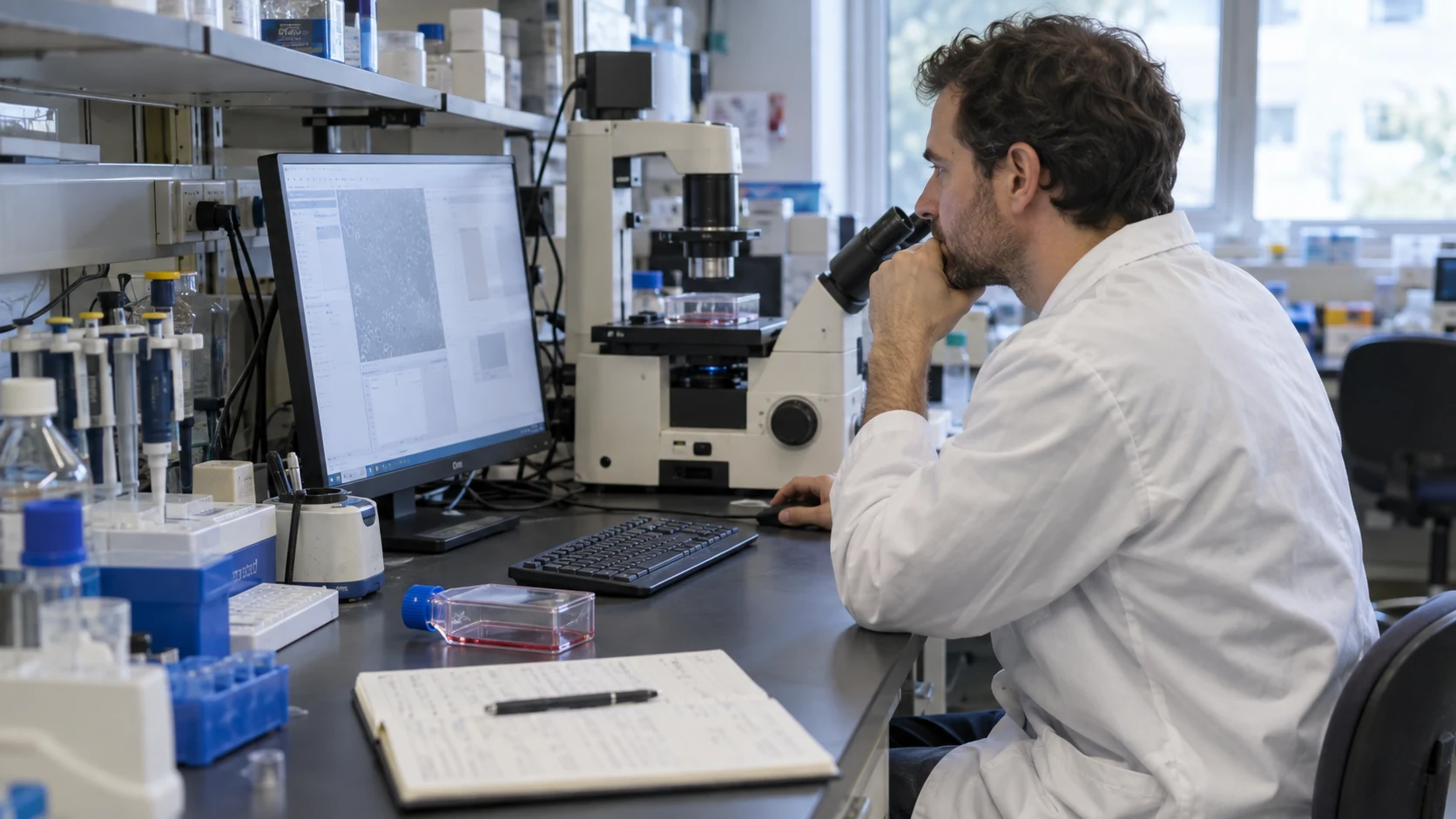

When a cell culture experiment fails to reproduce, the instinct is to blame the biology. In reality, the problem is often the software. More precisely, it is the mismatch between how biology actually works and how general-purpose lab management tools were designed to record it.
Electronic lab notebooks (ELNs) were built to capture experimental narratives, originally for chemistry. Laboratory information management systems (LIMS) were built to track samples through structured, repeatable pipelines. Neither was designed with the living, iterative logic of cell culture in mind: passages that increment with every split, lineages that branch across multiple researchers, media lots whose batch numbers determine whether a result can ever be reproduced, and feeding schedules that must be maintained around the clock regardless of who is in the lab.
The core problem: when a general-purpose tool encounters a cell culture workflow, it treats a passage event the same way it treats any other sample manipulation. It has no native concept of a cell line's generation, no structural relationship between a culture and the media lot used to maintain it, and no built-in mechanism for assigning ownership across a shared team. Researchers compensate with workarounds: custom fields, free-text notes, parallel spreadsheets. The audit trail that regulators and journal reviewers demand simply does not exist.
This article examines the specific architectural differences between biology-native platforms and general-purpose lab management tools, and explains why those differences translate directly into reproducibility, compliance, and team efficiency outcomes.
Key insight: According to landmark surveys cited in ALTEX (2025), more than 70% of researchers have tried and failed to reproduce another scientist's experiments, and more than half have failed to reproduce their own. The reproducibility crisis is not only a scientific problem; it is a data infrastructure problem.
The Fundamental Architecture Problem
General-purpose lab software is built around a universal data model. At its core, that model is a sample: an object with an identifier, a set of properties, and a chain of events. This model works well for small molecule chemistry, diagnostic testing, and quality control operations. It fails for cell culture because a living cell line is not a static sample.
A cell line has a generation. It has a passage history that determines its biological behaviour. It has a lineage that may branch when a vial is thawed and split across multiple researchers. It consumes media from a specific lot, and that lot's batch number is part of the experimental record. It requires scheduled interventions, not just event logging. It can drift genotypically over time, making passage number a critical variable rather than an administrative detail.
How general-purpose tools handle this (and why it fails)
When an ELN or LIMS encounters these requirements, it responds with customisation. Passage numbers become custom fields. Lineage relationships become manually maintained cross-references. Media lot numbers become free-text annotations in a notebook entry. Feed schedules become calendar reminders outside the system entirely.
The result is a data structure that looks like it covers cell culture but provides none of the structural guarantees that make the data trustworthy. Consider what happens when a researcher leaves the team:
-
Their culture records exist as notebook entries, not as structured data objects linked to the cultures they managed.
-
The passage history they maintained manually cannot be automatically inherited by whoever takes over.
-
Media lot associations are buried in text fields, not queryable across the dataset.
-
There is no ownership record that can trigger a handover workflow.
This is not a training problem or a process problem. It is an architectural one. A system that treats passage number as a custom text field will never enforce passage limits, will never automatically flag a culture that has drifted beyond its validated range, and will never generate a lineage tree that an auditor can review. Those capabilities require the data model to encode biological concepts as first-class objects from the ground up.
Research published in Science Translational Medicine identified cell line quality control as the single highest-leverage intervention for improving preclinical reproducibility, noting that misidentification and contamination result from QC procedures that "vary dramatically between laboratories." Standardisation at the software architecture level is the only scalable solution.
A Direct Comparison: Five Core Workflows
The architectural difference becomes concrete when you examine specific workflows that every cell culture team runs every week. The table below maps five critical operations against what a general-purpose ELN or LIMS provides versus what a biology-native platform like CellHood provides natively.
| Workflow | General-Purpose ELN / LIMS | CellHood (Biology-Native) |
|---|---|---|
| Passage tracking | Manual entry in custom fields; no automatic increment; no passage limit enforcement | Passage number auto-increments on each split event; configurable passage limits with alerts |
| Lineage & branching | Cross-referenced notebook entries; breaks when cultures branch across researchers | Native lineage tree from thaw to harvest; branches preserved with full ownership history |
| Media lot management | Free-text lot numbers in notes; no linkage to culture outcomes | Media lots are structured inventory objects linked to every feed event and culture record |
| Feed scheduling | External calendar or manual reminders; no system-level enforcement | Built-in scheduling tied to individual cultures; overdue feeds flagged in the platform |
| Team ownership & handover | Notebook entries associated with a user account; no structured handover mechanism | Cultures assigned to named owners; ownership transfer preserves complete audit trail |
What this means for an audit or publication
When a journal reviewer or regulatory body asks for the complete record of a cell line, a general-purpose tool produces a collection of notebook entries and custom field exports. A biology-native platform produces a connected, queryable record: thaw date, passage history, every feed event with its media lot number, the researcher responsible at each stage, and the harvest outcome.
A 2025 ALTEX analysis of the reproducibility crisis identified "traceability of work" as a key principle of Good Cell Culture Practice (GCCP 2.0), specifying that all components used must be traceable by product name, source, and batch/lot number. Meeting that standard through manual annotation in a general-purpose tool is theoretically possible. In practice, it relies entirely on researcher discipline rather than system enforcement, which is precisely why the problem persists.
The real risk: a Frontiers in Cell and Developmental Biology study analysing authentication data from 2024 to 2025 found that 4.7% of immortalised human cell lines were misidentified in 2024, with contamination happening within the laboratory during routine culturing rather than through historical mislabelling. These are active, ongoing failures in labs that almost certainly have some form of lab management software in place. The software is not catching them because it was not designed to.
The Customisation Trap
The standard counter-argument from general-purpose tool vendors is customisation. Most ELNs and LIMS platforms offer configurable templates, custom fields, and workflow builders. With enough configuration, the argument goes, any platform can be made to handle cell culture.
This argument misunderstands what architecture actually does. Customisation adds fields to a data model. It does not change the underlying relationships between objects. A custom field for "passage number" is a text string. It is not a counter that increments automatically, enforces a maximum, or triggers a downstream alert. A custom field for "media lot" is a label. It is not a foreign key that links a feed event to an inventory record, enabling you to query every culture ever maintained on a specific lot.
The hidden cost of configuration
Beyond the architectural limitation, customisation carries a significant operational cost that is rarely factored into software evaluations:
-
Implementation time: configuring a general-purpose platform for cell culture typically requires weeks of setup, often with vendor professional services involvement.
-
Maintenance burden: every time a workflow changes, custom configurations must be updated. Unlike purpose-built features, custom configurations do not receive automatic improvements.
-
Validation overhead: in regulated environments, every custom configuration must be validated. A biology-native platform with pre-built cell culture features reduces the validation surface considerably.
-
Knowledge dependency: if the person who built the custom configuration leaves, the institutional knowledge of how it works often leaves with them.
Industry analysis consistently shows that most LIMS platforms were originally built for small molecule R&D and "have trouble handling diverse molecular biology sample types without extensive customisation," resulting in "long setup times and expensive reconfigurations as biotech companies grow." This is not a failure of effort. It is a structural consequence of trying to retrofit a chemistry-native data model onto biology-native workflows.
The honest question for any lab evaluating general-purpose tools is not "can this be configured to handle cell culture?" but "what will it cost to maintain that configuration, and what will we lose when it breaks?"
Where Biology-Native Architecture Makes the Difference
The practical impact of architecture shows up most clearly in three scenarios that cell culture teams encounter regularly: multi-researcher collaboration, protocol standardisation, and regulatory or publication readiness.
Multi-researcher collaboration
Cell culture is rarely a solo operation. In a typical research team, multiple scientists share responsibility for the same cell lines, often across different shifts or working patterns. When a general-purpose tool is in use, handovers happen through informal communication: a message, a sticky note, a verbal update. The system has no concept of which cultures belong to whom, which feeds are overdue, or which researcher last touched a specific flask.
A biology-native architecture treats ownership as a first-class attribute of a culture. Every culture has a named owner. Every feed event, passage, and observation is attributed to a specific team member. When ownership transfers, the complete history transfers with it. The incoming researcher does not need to piece together the culture's status from scattered notebook entries; they see a complete, structured record.
Protocol standardisation across teams
Research on the reproducibility crisis consistently identifies inconsistent protocol execution as a primary driver of irreproducible results, noting that "different media preparations appear to influence the variation of cell viability and harvested cell counts in unexpected ways." Standardisation requires that the system enforce consistent data capture, not just provide a template that researchers may or may not follow.
In a general-purpose ELN, a protocol template is a guide. A researcher can deviate from it, add notes in a different format, or skip fields entirely. The system records what was entered, not what should have been entered. A biology-native platform can enforce required fields at the point of data entry, ensuring that every feed event captures the media lot, every passage records the split ratio, and every observation follows a consistent structure.
Regulatory and publication readiness
The GCCP 2.0 guidance is explicit: traceability of work is a key quality management principle, requiring that all components be traceable by product name, source, and batch/lot number. This is not an aspirational standard; it is increasingly required by journals, funders, and regulatory bodies.
Meeting this requirement with a general-purpose tool means relying on researchers to consistently annotate their entries with the right information, in the right format, every time. Meeting it with a biology-native platform means the system structurally prevents incomplete records from being created. The audit trail is not assembled after the fact; it is built continuously as the work happens.
"The contamination of cell lines is still a very real issue today... making it likely contamination happened within the laboratory culturing the cells and was not historical mislabelling." — Frontiers in Cell and Developmental Biology, 2026
The implication is direct: contamination and misidentification events that occur during routine culturing are precisely the events that a biology-native data model is designed to surface. When every feed, passage, and observation is a structured record linked to a specific culture, anomalies become visible in the data before they become irreversible in the biology.
When a General-Purpose Tool Is (and Is Not) Sufficient
It is worth being honest about the cases where a general-purpose ELN or LIMS genuinely suffices. Not every lab needs a biology-native platform, and the decision should be made on the basis of actual workflow requirements rather than software marketing.
A general-purpose ELN is likely sufficient when:
-
Cell culture is a minor, occasional component of a broader research programme
-
The team is small (fewer than three or four people sharing cultures)
-
Regulatory compliance and formal audit trails are not required
-
Passage tracking and media lot traceability are handled adequately through disciplined manual annotation
A biology-native platform becomes necessary when any of the following apply:
-
Multiple researchers share ownership of the same cultures
-
Media lot numbers must be traceable to specific experimental outcomes
-
Passage limits need to be enforced rather than simply recorded
-
The team needs to demonstrate GCCP compliance or satisfy journal authentication requirements
-
Onboarding new team members without losing institutional knowledge of culture history is a recurring challenge
-
The lab has experienced reproducibility failures that could not be traced to a specific cause
The inflection point for most growing research teams arrives when a second or third researcher joins the cell culture programme. At that point, the informal systems that worked for a single scientist start to break down. The question is not whether to move to a more structured system, but whether to do so before or after a reproducibility failure forces the issue.
As noted in industry analyses of lab software, the problems that matter most in modern R&D labs, including the inability to reproduce experiments and the difficulty of building on previous results, cannot be solved by better annotation habits within tools that were not designed for the purpose. They require a different architecture.
The Case for Purpose-Built Architecture
The argument for biology-native software is ultimately an argument about where complexity should live. In every lab, the complexity of cell culture management exists. The question is whether it lives in the software or in the researchers' heads, their spreadsheets, and their informal communication channels.
General-purpose tools push that complexity onto the team. They provide a flexible surface onto which researchers must map their own data structures, maintain their own conventions, and enforce their own standards. This works until it does not: until someone leaves, until a contamination event cannot be traced, until a journal reviewer asks for a complete passage history and the answer is a collection of notebook exports that require manual assembly.
Biology-native platforms absorb that complexity into the architecture. Passage tracking, lineage management, media lot traceability, feed scheduling, and ownership assignment are not features that need to be configured; they are the default behaviour of the system, because they reflect the default behaviour of the biology.
CellHood is built on this principle. The platform was designed specifically for cell culture management, not adapted from a general-purpose informatics tool. Every data relationship in the system reflects a real relationship in the biology: a culture belongs to a researcher, a feed event consumes a media lot, a passage increments a generation counter, a harvest closes a lifecycle. The audit trail that emerges from normal use of the platform is not a separate compliance exercise; it is the natural output of doing the work in the system.
For research teams that take reproducibility seriously, that distinction is not a feature comparison. It is a foundational question about whether their data infrastructure can be trusted to reflect what actually happened in the lab.
Ready to see biology-native architecture in practice? Start a 30-day free trial of CellHood with no credit card required, and explore how purpose-built cell culture management changes the way your team works.
Sources and further reading
- Referenced sourceElectronic lab notebooks (ELNs)
freelims.org
- Referenced sourceResearch published in Science Translational Medicine
www.science.org
- Referenced sourceA 2025 ALTEX analysis of the reproducibility crisis
altex.org
- Referenced sourceFrontiers in Cell and Developmental Biology study
www.frontiersin.org
- Referenced sourceIndustry analysis consistently shows
genemod.net
- Referenced sourceResearch on the reproducibility crisis
www.biorxiv.org
- Referenced sourceAs noted in industry analyses of lab software
synthace.com
See the connected culture workflow
Explore CellHood’s culture records and lineage views, then test whether they capture the relationships your team needs to review.